


Automated External Defibrillator (AED)
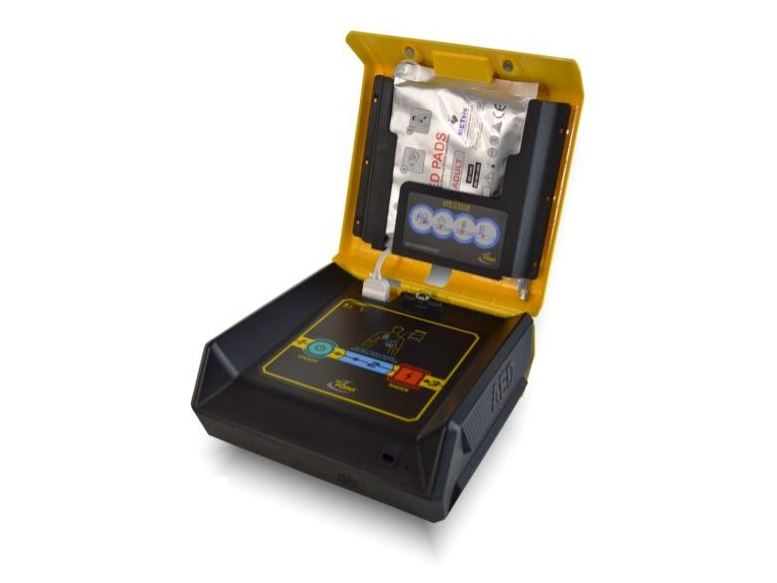
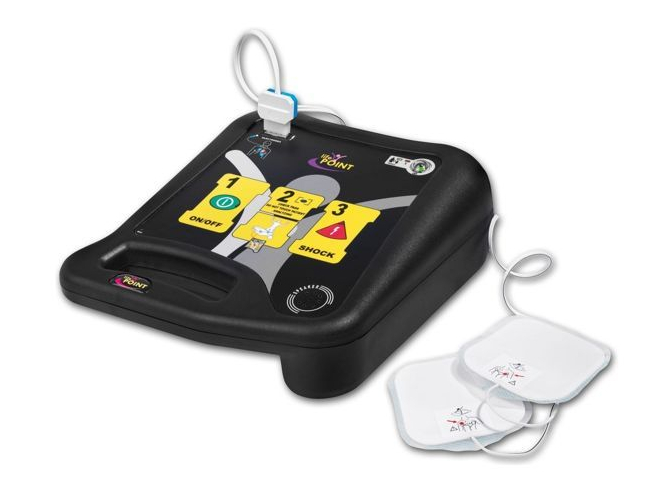
Life-Point Pro AED Automated External Defibrillator
Fully automatic external defibrillator with voice and visual guidance that can be used by first aiders without medical training. 1.85 kg.
- Three-step voice and visual guidance
- Self-test at every start, daily, monthly and every 6 months
- CPR metronome guidance
- Automatic paediatric pad recognition
- Motion and pacemaker detection
- 1.85 kg with carry bag and first aid kit
- 5-year warranty
- Applications
- Schools, shopping centres, airports, sports facilities, workplaces, hotels and public spaces
Defibrillator
- Operating mode
- Fully automatic
- Waveform
- Truncated biphasic
- Energy steps
- Adult 150 – 200 – 200 J · Child 50 – 50 – 50 J
- Charge time
- Typically < 10 s at maximum energy
- Shock capacity
- Typically 200 shocks (full battery)
- Impedance measurement
- 25 – 175 Ω
ECG analysis
- Analysis time
- Typically < 10 s
- Lead
- DII
- Bandwidth
- 2 – 25 Hz
- Detection
- Pacemaker detection, motion detector
Battery and self-test
- Battery
- LiMnO2, 12 V 4500 mAh
- Self-test schedule
- Every start, daily, monthly, every 6 months
- Self-test scope
- Battery, hardware, software, capacitor
Records
- Data
- ECG signal, events and voice recording
- Transfer
- METsis AED software (mini USB)
Physical
- Dimensions
- 9.5 × 27 × 24 cm
- Weight
- 1,850 g (battery included)
- Operating conditions
- 0 – 50 °C, 10 – 95 % RH
- Storage conditions
- -20 – 60 °C
METsis Medikal reserves the right to change technical values without prior notice.
Why Life-Point Pro AED?
Life-Point Pro AED is an automated external defibrillator designed so that a first aider can deliver an electric shock (defibrillation) in sudden cardiac arrest until the ambulance arrives. Its advanced ECG analysis software evaluates the heart rhythm itself; it delivers a shock if needed and otherwise guides the user to chest compressions. The user does not need to recognise heart rhythms.
Its self-test function keeps it ready to use at all times. When paediatric pads are connected, it automatically configures itself for a child. Rescue data is stored in memory for later review, and the software can be updated to follow changing guidelines. An optional wall mounting kit and wall cabinet make it suitable for any environment.
How to use an automated external defibrillator
- Check that the person is unresponsive and not breathing normally, and call emergency services.
- Switch on the device and follow the voice prompts.
- Attach the pads to the bare chest as shown on the pads.
- Make sure nobody touches the patient while the device analyses the rhythm.
- If a shock is advised, make sure everyone stands clear; the device delivers the shock.
- Continue cycles of 30 chest compressions and 2 rescue breaths as guided by the device.
Use on children
| Age group | Application |
|---|---|
| 0 – 1 year | Defibrillation not recommended |
| 1 – 8 years (under 25 kg) | With paediatric pads |
| 8 years and over (over 25 kg) | With adult pads |
If you already own the device
- Keep the device where it can be seen and reached easily; follow the self-test indicator.
- Have periodic maintenance and calibration carried out only by an authorised Life-Point service.
- Make sure pads, accessories and batteries are original.
- Have the software updated to current resuscitation guidelines at an authorised service.